Today, packaging is not just a container in the food industry. It serves a purpose: it maintains freshness, food safety, and product shelf life, and communicates product value at the point of sale. One of the most commonly used materials in food packaging today is PET—polyethylene terephthalate—plastic. Understanding these factors is critical for suppliers such as Xiamen Xiefa Packing Co., Ltd. to provide packaging solutions that truly satisfy the needs of customers in retail, food service and industrial applications.
Why PET Plastic Dominates Food Packaging
PET plastic is a transparent, lightweight and strong plastic that combines the best of both worlds with its performance and usability. It's very clear, so people can look at the product without having to open the package. Concurrently, PET offers excellent moisture, oxygen and contaminant barrier properties to ensure food quality throughout storage and transport.
Another reason for the prevalence of PET is that it is very versatile. It can be thermoformed into nearly any shape or size for trays, cups, clamshells or containers. It can also be extruded into films and sheets or precision injection molded parts. This versatility can be used in applications from fresh produce display to takeout beverage carriers, as a single material family can be used in multiple applications. This simplifies packaging supply and makes it possible to guarantee quality across a wide range of products.
PET recycling is also possible, and a number of PET grades can be accepted in recycling streams across the globe. With evolving sustainability regulations and customer requirements, PET's recyclability provides an advantage over some other materials that are challenging to process. Xiamen Xiefa Packing Co., Ltd. takes these factors into account when developing products, so that PET packaging products can meet international import standards and market requirements.
PET Plastic in Food Storage Applications
PET's functional properties are used most extensively in food storage. In any food handling environment—from a supermarket to a commercial kitchen or a larger commercial facility—packaging should prevent spoilage, damage, and contamination. PET has a number of high-performance applications for storage.
A widely used application is fresh produce storage. PET supermarket fresh produce trays offer a firm, transparent base for fresh produce, cut fruit and vegetables. The trays also facilitate easy stacking and display, while keeping fragile items safe from damage. Due to its moisture-resistant properties, PET is not affected by the humidity in most refrigerated display cases. This is perfect for berries, salads and ready-to-eat produce where there's a need for visibility and protection.
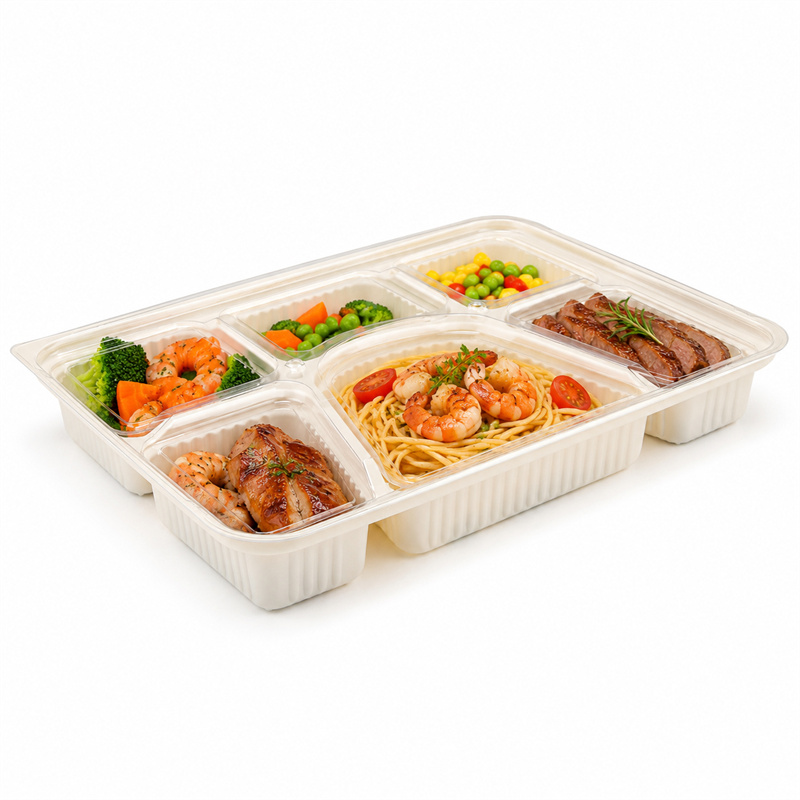
PET is used in food service and takeout to store and transport prepared food, soups and cold food. PET containers are leak-resistant and can withstand a range of temperatures, making them suitable for both hot and cold applications. PET takeout containers can be closed with a lid or film for a leak proof package, which eliminates spills on delivery. This is especially significant, given the increasing proportion of food sales in the delivery and takeout sectors.
PET is also employed in egg trays and cartons, where its strength and impact resistance help prevent damage to the eggs during handling and transport. Likewise, food grade bags and wrapping materials from PET films provide a balance of transparency and barrier properties for baked goods as well as snack and dry foods. In industrial environments, specially designed pallets and trays suitable for automation help in managing and storing food products efficiently at a large scale.
PET Plastic in Retail Display
Packaging has a different purpose to each retail display. The package should not only protect the product, but also attract attention, convey brand identity, and make shopping easier. PET plastic is ideally suited to these requirements.
PET's transparency enables retailers to showcase food products in a way that enhances their color, texture and freshness. This visual clarity can be a key driver in the decision-making process for customers in a retail saturated marketplace. For fresh produce, the supermarket fresh produce trays enable customers to view the quality of the fruits or vegetables without touching them and hence boost their trust and minimize handling damage.
Printed graphics, embossing and structure can also be added to PET packaging, helping to boost the presence on the shelves. The custom printing process can be used for PET trays, cups, and bags to showcase logo, nutritional content, and promotional messages. High quality print finishes are acceptable on PET, giving the package a premium, professional appearance—important for retailers marketing products in competitive categories.
In addition to visual appeal, PET packaging enhances the practical aspects of retail displays. Cafes and fast-food restaurants can serve a variety of drinks in a stable, easy-to-carry format using PET takeout drink carrier trays. PET beverage cups are clear and robust, giving customers a view of their drink without compromising on convenience. PET films can be made into wrapping papers and printable food bags which provide visibility yet are hygienic, ideal for wrapping sandwiches and pastries and other grab-and-go food items.
Efficient stacking and organizing PET packaging is also beneficial to retailers. Many PET trays and containers have nesting or stacking capabilities to help make the most of shelf space and restocking. This is particularly relevant in high turnover settings where any delays or inefficiencies can have a significant impact on profitability.
Customization and Design Flexibility
One of PET plastic’s major advantages is its versatility. Food packaging is seldom one size fits all. Each product has a unique shape, size, barrier and function. PET can be tailored to suit these diverse requirements by custom printing, custom structure and form, custom materials and functionality, and custom accessories and components.
For instance, a produce tray with particular drainage openings might be required in order to guarantee there is no accumulation of moisture. A food service operator might need a takeout container that has separate compartments for various types of food. For an industrial client, a pallet design that incorporates an automated handling system might be required. All these needs can be satisfied with PET solution. Xiamen Xiefa Packing Co., LTD. can provide such customization. Customer can receive free design services, and our typesetting specialists will explain the process and provide 3D design output so customers can visualize the product before production and avoid confusion.
Structural customization also has an impact on usability. A good designed PET container will perform smoothly when opening or closing, and the seal is tight, the stacking is stable. While these details may seem insignificant, they can make a huge difference in user experience—whether for a restaurant customer picking up out takeout or a warehouse employee loading a pallet.
Quality Assurance and Compliance
Packaging for food is subject to very stringent safety and quality requirements. PET plastic for food contact applications needs to be produced under controlled conditions where it is not possible for it to be contaminated and where no harmful substances can be transferred to the food. This involves meticulous quality control throughout the manufacturing process, from raw materials to final quality control.
International certificates come into play here. Compliant packaging allows for hassle-free and non-rejected imports across borders to the whole world. This compliance is not an option, but a starting point for suppliers that serve customers in the retail, food service, industrial and hospitality sectors. Quality control and cross-border procurement are the two major strengths for Xiamen Xiefa Packing Co., Ltd., and it is committed to providing PET packaging solutions that satisfy the regulatory and performance requirements of various countries and industries.
Conclusion
PET plastic has become one of the most prominent materials used in food packaging, as it excels in several aspects, including clarity, strength, barrier properties, recyclability, and design flexibility. It is used to protect foods which are being stored from spoilage and damage. It is used in retail display to increase visibility and brand appeal. In both applications it ensures efficiency, safety and customer satisfaction.
Understanding PET plastic is not simply a matter of supplying a material for food packaging; it's about comprehending the performance of the material under real-world conditions. Whether it's trays at the supermarket, take out packaging, a cup for drinks, egg trays, printed food packages or tailored industrial pallets, PET packaging solutions are constantly adapting to the needs of the food industry. Xiamen Xiefa Packing Co., Ltd. will still ensure that PET packaging solutions are of top-notch quality, customizable, and compliant with the customer's needs to present their products at their best.