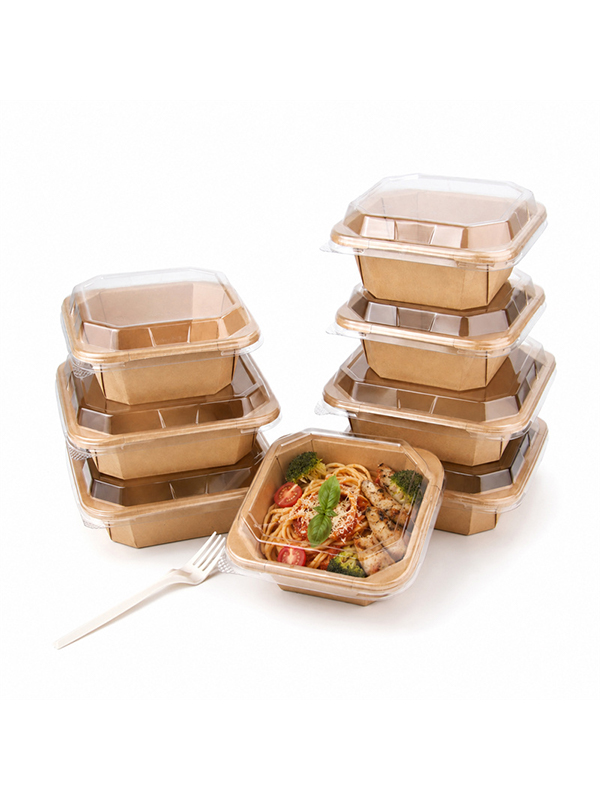
The term “compostable” is used frequently and often becomes a vague, feel good label when buyers are looking for eco-friendly disposable tableware. In fact, it's a technical claim with specific conditions, measurable results and legal consequences in many markets. The difference is important to a food packaging supplier such as Xiamen Xiefa Packing Co.,Ltd., as customers in retail, food service, industrial, and hospitality applications all require packaging that work as expected and meet real import requirements.
Not everything that is compostable will break down completely in every environment. It means the product can be composted under conditions similar to those for other compostable products, at a rate that leaves no visible or toxic residue. This is in line with existing standards like ASTM D6400 and EN 13432, which set accepted biodegradation percentages, disintegration periods and ecotoxicity testing. If a product breaks down in a lab over an unknown period of time, it does not necessarily break down in a commercial facility. When composting in a home backyard bin, a product that composts in an industrial system may not compost a home bin. These are not lexical distinctions. They decide whether a disposable tray, cup or takeout container will actually be permitted to be sold for composting in a specific area.
The Gap Between "Biodegradable" and "Compostable"
A lot of suppliers interchangeably use the terms biodegradable and compostable. They are not the same. Biodegradable is a more general term – virtually anything can be broken down over time and in suitable environments. The fact that a conventional plastic bag takes decades to break down is of little help to anyone dealing with waste daily in a food service operation.
A biodegradable product does not have to be compostable, because compostable materials must meet specific time-bound and quality-bound requirements. For instance, a bagasse or PLA-blended compostable takeout container should break down within a specified timeframe under industrial composting conditions, usually 12 weeks or less, and should not release heavy metals or toxic residues which adversely affect soil. When Xiamen Xiefa Packing Co., Ltd. is supplies compostable supermarket fresh produce trays or takeout containers, the important question is not whether the product is biodegradable, but in what environment it degrades, within what timeframe, and under whose certification.
Why Certification Bodies and Labels Matter
Compostability is a technical claim and independent certification is the only reliable guarantee. The seedling logo with the EN 13432 is commonly known in Europe. The BPI Compostable logo under ASTM D6400 is the widely-adopted guideline in the United States. Other regions have similar certification schemes. The certifications do not rely on self-declaration, but on testing done by a third party laboratory.
That's where international certifications come into play as a valuable purchasing filter. A food packaging supplier who says it is compostable but isn't creates a risk for the buyer: rejected shipments, regulatory penalties, consumer backlash. Xiamen Xiefa Packing Co., Ltd. places great importance on compliance with the import regulations of global markets, this is because compostable claims are subject to scrutiny at customs and by retailers. The certification isn't just a nice-to-have for a supermarket buying fresh produce trays or a hospitality group ordering takeout drink carrier trays. It's the distinction between a sustainable claim and a greenwash liability.
Material Reality: What Compostable Tableware Is Actually Made Of
Compostable disposable tableware isn't a single product. It is a group of materials with varying performances. Common feedstocks include:
Corn starch or sugarcane can be used to make polylactic acid (PLA) which is used in cold cups, lids, and some food containers.
The fibrous remains of sugarcane juice, known as bagasse, are often formed into takeout containers, trays and plates.
Palm leaf, areca leaf, and wheat straw are used for plates and bowls to give a natural look.
Paperboard with compostable coatings is used for packaging such as wrapping paper, food packages and beverage cups.
Limits exist for each material. If formulated it can melt at high temperatures, which is not suitable for hot coffee. Bagasse is also very hard and may be heavier and more costly to transport. Coatings on paperboard which are intended to be compostable should be compostable themselves or the paperboard will not be compostable. A supplier that can provide materials and functionality like Xiamen Xiefa Packing Co., Ltd., can match the material to the actual use case: a takeout container for hot soup, a supermarket fresh produce tray for refrigerated display, a beverage cup for cold drinks, or a food-grade apron and glove set for handling.
Industrial vs. Home Composting: The Condition Most Buyers Miss
The one thing that is most often misunderstood when it comes to compostability is the composting environment. The vast majority of certified compostable disposable tableware is intended for industrial composting systems that have a high temperature, controlled moisture and microbial activity. That's not the kind of environment that a home compost pile is going to provide. A certified compostable product can remain relatively unbroken in a backyard compost pile for months before decomposing.
This is significant for operators and retailers in the food service industry because the end-of-life process is dependent on local infrastructure. Even an industrial compostable takeout container can be sent to the landfill if there is no collection service that complements industrial composting. Compostability is both a system property and a property of the product. Buyers need to ask the question: Where is this packaging going to end up after it's used? Will the municipality or waste hauler accept packaged foods that are made from compostable materials? Is that stream certified for the product?
How to Evaluate a Compostable Supplier Without Getting Lost in Claims
The real checklist for procurement teams is shorter than the marketing claims suggest. First, request certification documents that are related to recognized standards, and not simply a statement on a website. Second, match the material to the application: heat resistance, grease resistance, leak resistance, and structural strength requirements all vary. Third, verify that the custom printing, custom structure and custom accessories do not affect compostability. A compostable container with a conventional plastic lid or a non-compostable label is not compostable. Fourth, confirm the quality assurance and logistics of the supplier to ensure a consistent batch as some compostable materials may be more prone to storage and moisture issues than traditional plastics.
Xiamen Xiefa Packing Co., Ltd. does this by means of its own mold-making workshop, technical team and long manufacturing partnership, which enables it to have control over structure, material selection and quality assurance. The company has more than 2,000 SKUs that it owns, and has over 50 compostable product design patents, which enables it to provide free design services, free samples, and free OEM/ODM customization without losing the compostability claim from the actual product construction.
Conclusion: Compostable Means Accountable
Compostable doesn't automatically mean eco-friendly, but it isn't an empty statement either. A true compostable claim relies on the chemistry of the materials, certification, composting facilities and product design. If someone is purchasing eco-friendly disposable tableware, the most important question is not if it sounds like it's sustainable, but if it's sustainable in a defined environment, to a defined standard, with documentation to prove it. A food packaging supplier who is aware of this distinction, and can provide it in food packaging, take out containers, beverage cups, wrapping paper and industrial automation pallets is providing more than a label. It's providing accountability.
Table of Contents
- The Gap Between "Biodegradable" and "Compostable"
- Why Certification Bodies and Labels Matter
- Material Reality: What Compostable Tableware Is Actually Made Of
- Industrial vs. Home Composting: The Condition Most Buyers Miss
- How to Evaluate a Compostable Supplier Without Getting Lost in Claims
- Conclusion: Compostable Means Accountable